
Gratis verzending(m.u.v. XL en glas transport)
Voor 14:00u besteld, vandaag verstuurd
Uit voorraad geleverd
Jouw aankoop wordt beschermd met Trusted Shops 
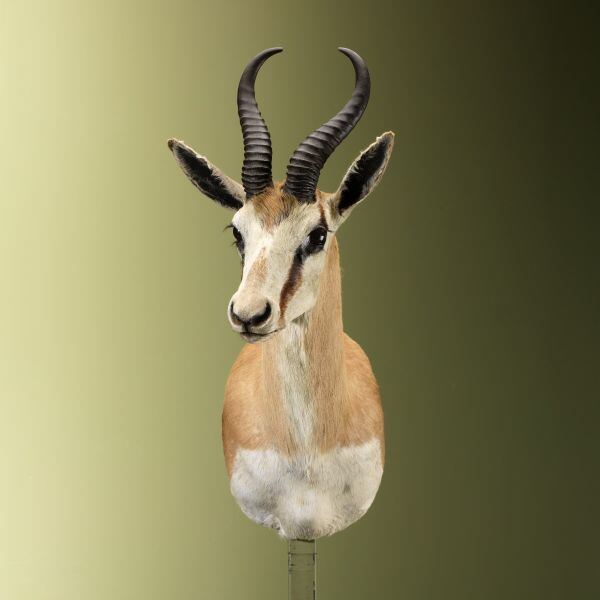
SKU: 4647 Springbok H64B26D44
Antidorcas marsupialis, commonly known as the springbok, is a medium-sized antelope indigenous to the southern regions of Africa. The species is renowned for its remarkable leaping ability, an action known as "pronking," where the animal springs into the air with its back arched and legs straight. This unique behaviour is thought to be a display to predators, showcasing their fitness and vitality. The springbok is also notable for its distinctive appearance, characterised by a striking contrast of its reddish-brown body, white underbelly, and a dark stripe running along its flanks. Taxidermy enthusiasts often appreciate the springbok for its elegant form and the challenge it presents in capturing its dynamic posture through taxidermy.
The Latin name, Antidorcas marsupialis, hints at the unique pouch-like skin flap along its back, which opens to reveal a crest of white hair when the animal is excited or alarmed. This feature is not only a fascinating aspect of their biology but also adds to the aesthetic appeal when preserved. In the realm of taxidermy, the springbok is a prized specimen due to its graceful stature and the vivid colours of its coat, which make for a striking display piece. The art of taxidermy allows for the preservation of the springbok's natural beauty, capturing the essence of the wild and bringing a piece of the African savannah into any space.
An intriguing fact about the springbok is that it was once so numerous in the wild that vast herds, known as "trekbokke," would migrate across the plains in search of water and grazing, a sight that could last for days. Today, while such migrations are rare, the springbok remains a symbol of the African wilderness and a testament to the continent's rich wildlife heritage. Whether viewed in its natural habitat or as a meticulously crafted taxidermy piece, the springbok continues to captivate and inspire those who appreciate the beauty and diversity of the animal kingdom.
Every mounted animal that By Max delivers is delivered with the necessary legal documents. This can be a CITES document, declaration of origin or just the invoice (this depends on the species). These documents guarantee the origin and legality of the preparation.
 EN
EN NL
NL DE
DE FR
FR